
Pre.S. This is my first minibook in a series where I’ll go deeeeep on how expert entrepreneurs can build compound authority on an idea they own. I suggest devouring it on my Substack for the best experience.
Pssssst: scroll to the end to get my Rebel POV exercise. It’ll help you extract the seeds of your first Ownable Idea.
Hey there,
I want to run a quick experiment.
I’m going to name a few phrases.
Just notice what happens in your brain as you read them.
“Start With Why.”
“Atomic Habits.”
“Boring Businesses.”
I’m guessing a name appeared in your mind as you read each one. You didn’t need a photo, bio, or any additional clues to know the entrepreneur who coined each idea. Your brain simply connected the words to the person.
That’s what it feels like when someone owns an idea.
An Ownable Idea is a strategic territory you claim and become known for.
Think of it like intellectual real estate that, when occupied effectively, makes you an obvious authority, spreads while you sleep, and generates business demand.
Every expert who breaks through owns one idea that travels without them.
Before Simon Sinek gave his famous “Start With Why” TED Talk, he was a relatively unknown marketing consultant. Today, he charges six figures for a keynote.
Before James Clear published Atomic Habits, he was a blogger with a modest following. He’s now a best-selling author who has sold over 20 million copies.
Before Codie Sanchez started talking about “boring businesses,” she was a Wall Street finance professional buying laundromats and car washes. . Now, she runs a portfolio worth tens of millions.
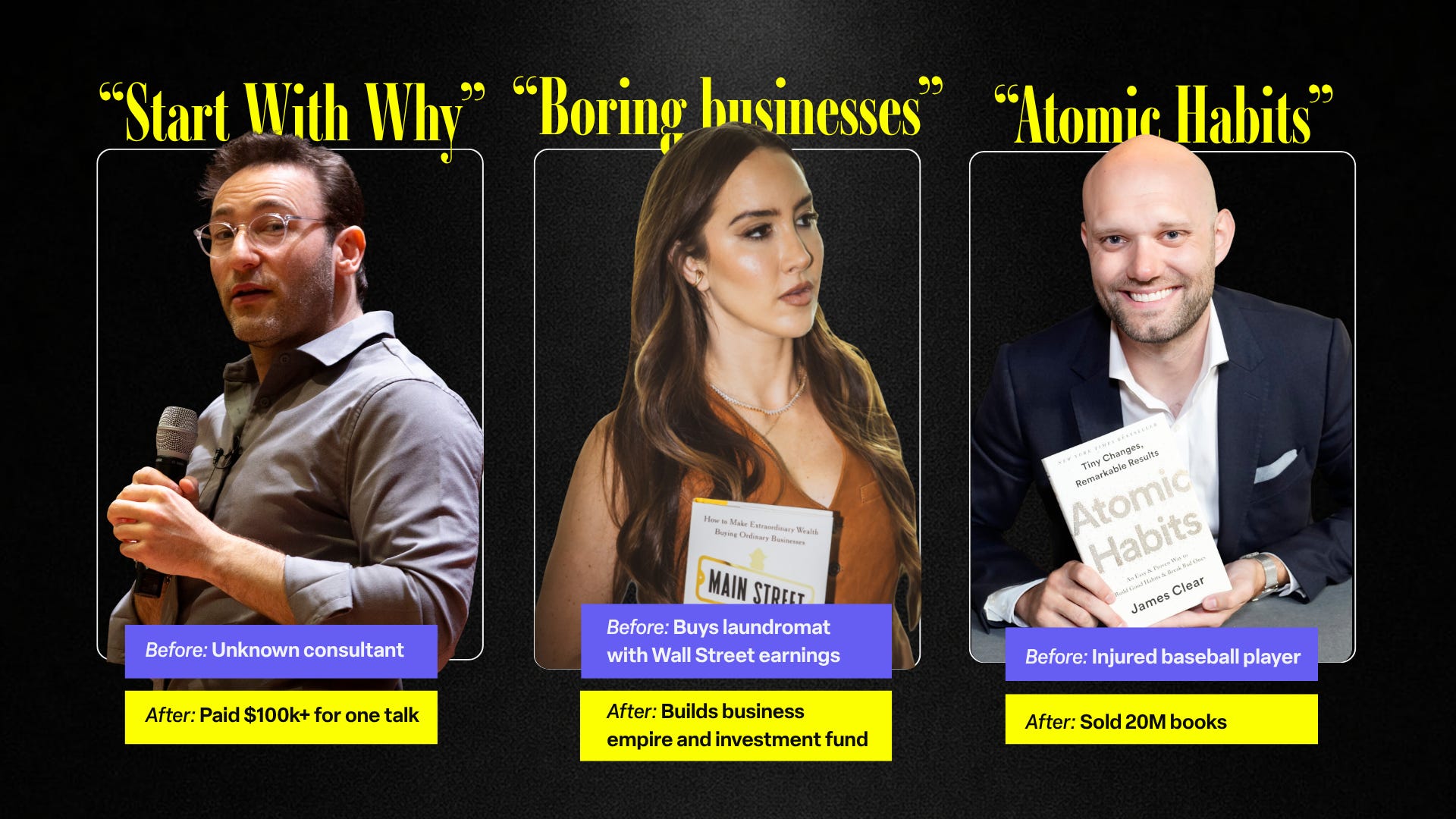
Yup. One idea changed the trajectory of each entrepreneur’s business.
Now, it’s not as simple as it sounds. And, believe me, it’s certainly not “easy”. (Read on to see why.)
Becoming known for your thinking has gone from a valuable luxury to an essential competitive advantage. Doing good work isn’t enough to build a thriving business anymore, and neither is grinding out “good” content consistently.
An Ownable Idea is an authority shortcut.
That’s always been true. But today, it’s urgent.
Yet most people never find their Ownable Idea—usually because they’re too close to see it or too scared to commit. They have plenty of brilliant thinking. They just can’t tell which idea is worth owning. So they share tips, hot takes, and “valuable content,” and wonder why nothing sticks. Meanwhile, someone with 1/10 their depth walks away with all the authority (and clients).
I’ve spent years studying how experts build authority.
First through my own journey, building a 7-figure solopreneur business and an audience of over 300,000 across platforms around my first Ownable Idea, and then helping other entrepreneurs build profitable personal brands.
In 2022, I co-founded the UNIGNORABLE Challenge, originally a 32-day personal branding challenge. More than 1,900 entrepreneurs completed the challenge, and many went on to build profitable audiences that catapulted their business growth.
I bet you recognize a few of our internet-famous alumni, like Eric Partaker, Alex M. H. Smith, and Dr. Nadya Zhexembayva.

The UNIGNORABLE Challenge ended with the exercise I cared about most: helping people find their big idea—what I now call an “Ownable Idea”. Back then, finding and committing to an Ownable Idea was an optional super-booster for brand building. Today, I think it’s the whole game.
When I started getting serious about creating content in 2020, the game was simpler. If you understood attention and persuasion and consistently published good content, you could build an audience.
But the content game has changed…
Good content is everywhere now because AI made it cheap and infinite. “Helpful” stopped being enough to get noticed, let alone get hired. The experts who break through today won’t win on content volume. They’re the ones known for an idea they own.
So I looked into how they did it. I studied the entrepreneurs who’d become synonymous with a single idea and asked what they had in common. I discovered that the best and most widely known Ownable Ideas weren’t random flukes. Even though the experts who named and claimed these ideas may not have followed the same deliberate process, the ideas that made them famous share a remarkably similar structure.
Which raised a question I couldn’t stop thinking about: could you engineer an Ownable Idea?
I believe you can. And I’m on a mission to help more big-brained experts find, shape, promote, and own their first breakthrough idea. One that positions you as an authority, spreads while you sleep, and sticks in your brain like superglue.
This mini-book explains what an Ownable Idea is, why it works, the different forms it can take, and why I believe it’s becoming one of the most valuable assets an expert entrepreneur can build. More than that, it will change how you think about expertise itself. Because when your thinking is the product, the goal isn’t more visibility—it’s compound authority.
Let’s begin…
The Problem With Selling Your Thinking
Have you ever lost work to someone who wasn’t as good as you?
Their thinking was thinner and their track record shorter… but they got the call, and you didn’t.
It stings, and it feels unfair. But it isn’t random. Being the best isn’t enough, because your buyer usually can’t tell who is “the best”. That’s not their fault—it’s the nature of what you sell.
With most products, a whole ecosystem exists to help buyers choose. They Google their options, compare features, read third-party reviews, check prices, and weigh their options against the alternatives. If you’re buying a new pair of shorts or a SaaS tool, you don’t need to know or even like the person who made it. Yeah, it might help. But good product marketers and demand gen teams don’t need their CEO to be famous. There are plenty of other ways to sell.
But as a consultant, agency owner, coach, strategist, or creator… you’re NOT selling a product. You’re selling your judgment. I’m talking about your point of view, pattern recognition, and particular way of seeing a problem.
Your thinking IS the product.
It’s almost impossible for a buyer to evaluate your thinking before they hire you. Because if they could judge the quality of your expertise flawlessly just by looking at your work, they’d already know how to do what you do and might not need you at all.
So, buyers fall back on what they can judge by looking for signals:
Do you name their problem more clearly than they can?
Do you see something they’ve missed?
Do you make them feel understood?
Have you helped people like them?
Buyers lean hard on these signals because of the way the human brain makes decisions. But there’s one signal a product never has to earn: do they like you?
Products get compared. People get judged.
A dishwasher doesn’t have to be relatable. A CRM doesn’t have to win you over with charm. Sure, it helps. But the moment the product is a person’s thinking, every human instinct we use to size up other people switches on.
That’s why…
The First Name That Loads Wins
Think back to the experiment at the beginning of this book.
When you read “Start With Why”, you didn’t consciously search your memory. Simon Sinek’s name simply appeared. When you read Atomic Habits, James Clear loaded just as quickly. That wasn’t luck. That was your brain doing what brains do: taking shortcuts.
Every day, your brain is bombarded with more information than it could ever fully process.
If it stopped to evaluate every message intently, you’d never get anything done. So it relies on mental shortcuts. Psychologists call them heuristics: fast, efficient rules of thumb that help us decide what deserves our attention, what feels credible, what we’ll remember, and who we’ll trust.
Your buyer’s brain is no different.
Buyers rarely compare every possible expert. They ignore most. Remember a handful. They shortlist even fewer. And very often, the expert who comes to mind first is the first person they call.
An Ownable Idea matters for people who sell their thinking because it leverages how lazy brains work:
When you give an invisible problem a memorable name, people recognize it more easily.
When you compress a complicated argument into a simple phrase or framework, people understand it faster.
When you consistently associate one person with one powerful idea, people retrieve that association more quickly when the right problem appears.
In other words, an Ownable Idea reduces the cognitive effort required to remember you. Once you’re remembered, it does something a product never could:
An Ownable Idea lets a buyer experience your thinking before they ever reach out.
It’s proof of judgment, delivered in advance. The moment your idea reframes how they see their own problem, they stop wondering whether you’re any good and start assuming you’re the expert. That’s what makes you believable—and believability is what makes someone trust you with the work.
It’s why they hire you.
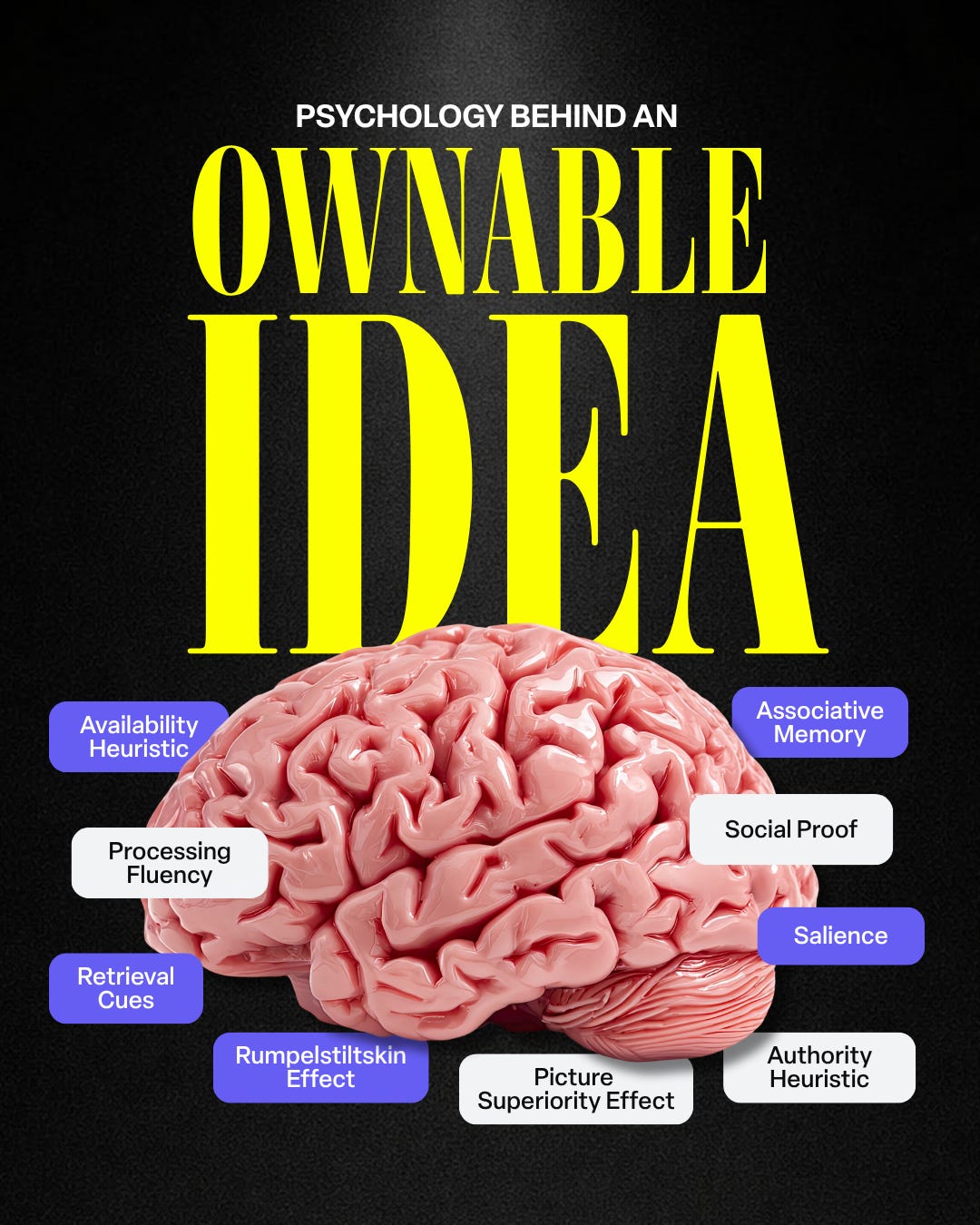
Now we’re only scratching the surface here…
The science behind why Ownable Ideas work goes deep and deserves far more attention than I can give it here, which is why I’m writing an entire mini-book devoted to it soon.
For now, know this:
Ownable Ideas spread because they make it easy for brains to do what brains naturally want to do, which is make associations and solve future problems.
That’s the shift worth understanding before we go any further. Everything that follows—what an Ownable Idea is, why it works, and the forms it can take—is in service of one goal: making your thinking visible, credible, and impossible to confuse with anyone else’s.
Which raises the obvious question: what does it take to build one?
It’s more than a catchy phrase—a lot more.
What Is An Ownable Idea? (And What Goes Into One)
The term explains itself once you split it in two.
The ‘Idea’ is your argument. It’s what you’ve come to believe about your buyer’s world that others haven’t seen yet.
It’s your answer to questions like:
What do they want?
Why are they still stuck?
What’s the truth that changes how they should think about the problem?
The ‘Ownable’ part is the expression that travels, repeated.
What makes an idea ownable is the distinctive language you use to make it memorable. The story you tell that shapes what you believe into a message your audience didn’t know they needed to hear. The framing that feels fresh yet familiar.
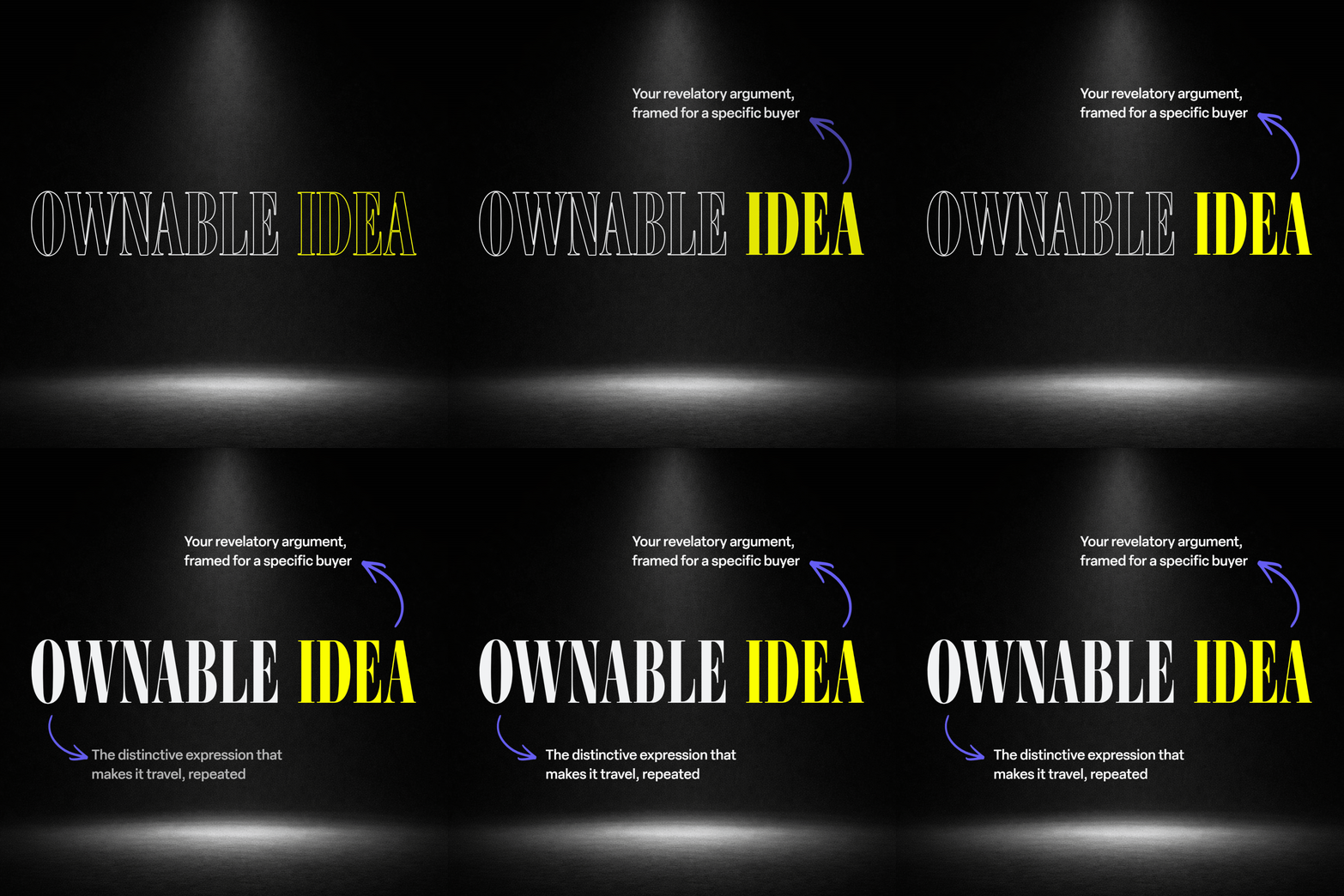
The order matters.
You start by clarifying your revelatory argument—matching what you say to what a specific buyer needs to hear. You then figure out how to express it in a distinctive way that travels.
Clarify your argument, with a specific buyer in mind.
Find an ownable way to express it.
This is the part many people misunderstand. They hear “Ownable Idea” and focus too much on the ownable part. So they craft a clever phrase without doing the foundational work of building a revelatory argument. The result is language that sounds good… but goes nowhere. There’s nothing beneath it to connect what the entrepreneur wants to say to what their buyer needs to hear.
The ownable expression only becomes powerful if the underlying argument is sharp.
That probably sounds abstract. So let me show you what it looks like when someone gets the order right.
What’s underneath “Boring Businesses”
Let’s go back to one of the phrases from the opening exercise.
“Boring Businesses.”
Those two words probably loaded a name into your mind—Codie Sanchez—along with a surprisingly rich set of associations that represent her worldview. She spent years on Wall Street, mastering the world of investment banking and finance. Then she did something “contrarian”: she started buying laundromats and car washes. Sayyyy what!!?
Codie argues that boring main street businesses are secretly better ways to get wealthy than the unicorn startups or C-suite jobs everyone’s chasing. But Codie didn’t begin with two catchy words and build a business around them.
So let’s strip away the phrase and look at what she constructed before those two words could carry any weight:
She had a differentiated lens on a common problem. Codie spent years inside elite finance companies learning exactly how dealmaking and M&A worked at the highest level. Like her peers, she wanted to be rich. But she also wanted to be free, so she used her expertise to look for opportunities others ignored: unglamorous, cash-flowing local businesses like laundromats.
She targeted a specific person at a specific moment. Codie knew there were other smart people like her who wanted to build wealth, but felt locked out or gaslit by the current system. Many people were hungry for a different path to ownership.
She made a distinctive argument that defies prevailing wisdom. While the loudest business voices glorified tech startups, venture funding, or the climb up the corporate ladder, Codie railed against those paths. She claimed boring businesses were an easier way to get rich that everyone was ignoring.
She created a shared enemy. An idea travels faster when it has something to push against. Codie attacked faceless mega-corporations and private equity rollups that swallow up Main Street and hoard the wealth.
She crafted a strategic narrative and key messages she plays on repeat. Codie tells the same story over and over, using powerful mantras at each stage of the buyer journey. “Forget sexy startups. Get rich buying boring businesses.” “Become a Main Street Millionaire.” “Join Owner Nation.” She makes the same argument from 1,000 angles. And while her exact words change, her message stays consistent.
She promoted an aspirational identity for her buyer. The “contrarian thinkers” who buy into Codie’s argument don’t see themselves as merely investors. They see themselves as freedom fighters, winning a game rigged against them from the start. That identity makes them repeat her language as if it were their own.
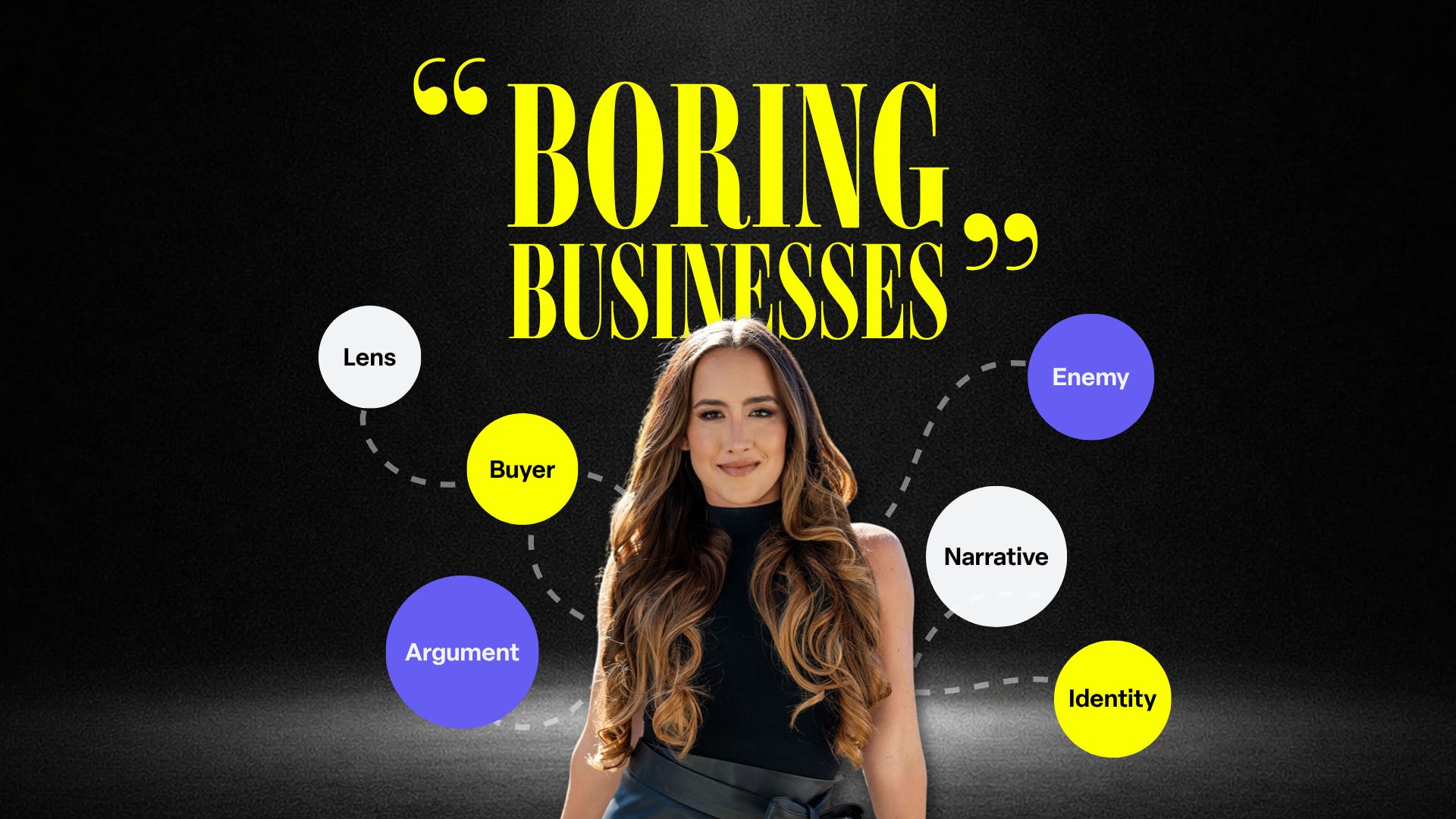
On top of all of that comes the phrase “boring businesses.”
It sits on a deep strategic foundation: an earned lens on a problem, a buyer, an argument, an enemy, a story, and an identity. See the order? The argument came first. “Boring Businesses” was simply the expression that gave people something to hold onto so her thinking spread.
Sticky words spread, but the foundation makes them worth spreading.
An Ownable Idea is the way you see problems—the lens nobody else brings—built on a strategic foundation, compressed into language sharp enough to spread.
It starts with the argument. (Building yours is a process, which I’ll walk you through in the next mini-book.)
Once the argument is clear, you connect it to a story and compress it into language sticky enough to spread. And then comes the hardest part—committing to repeat that argument across hundreds of pieces of content, often over years, until it becomes yours.
(See? I told you it wouldn’t be easy.)
An Ownable Idea doesn’t have to be brand new, but it does have to be earned to be believable.
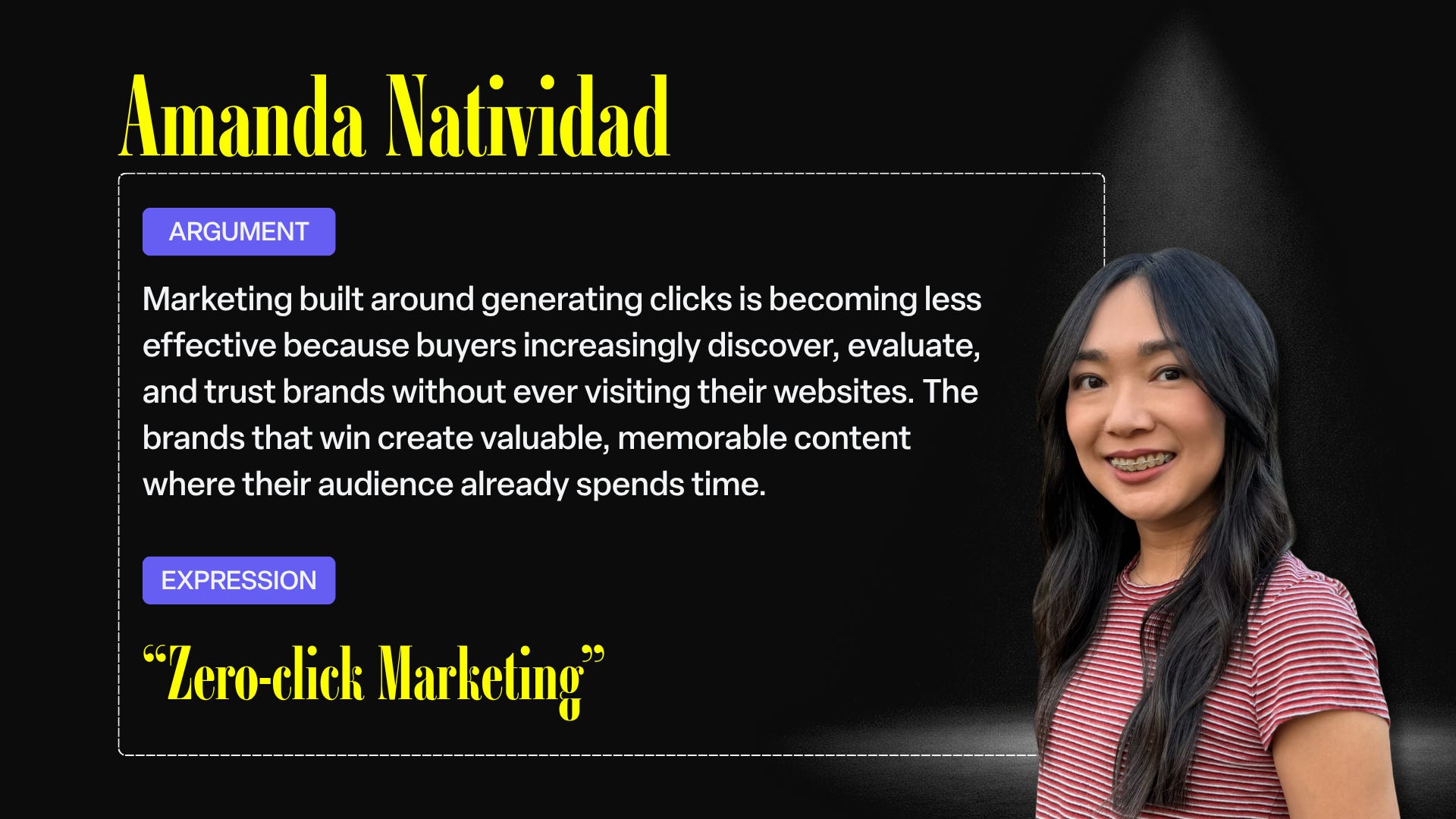
Amanda Natividad worked as a content marketer for years before an epiphany in 2014 set her on the path to coining “Zero-Click Content,” a new marketing discipline and (soon-to-be) best-selling book.
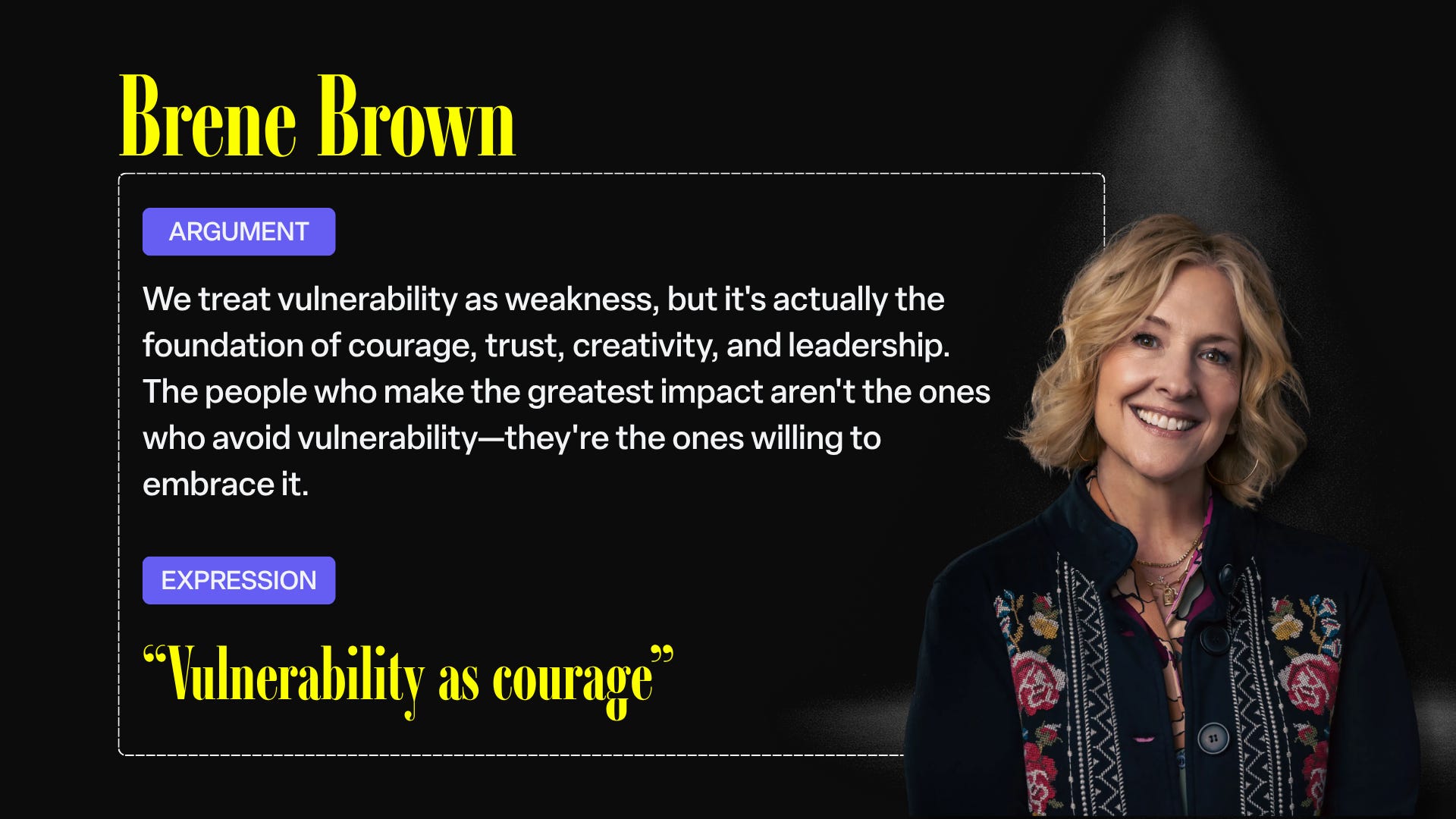
Brene Brown spent two decades studying courage, shame, and vulnerability before sharing her shocking findings in her viral TED Talk and book, Daring Greatly, which sold over 2 million copies.
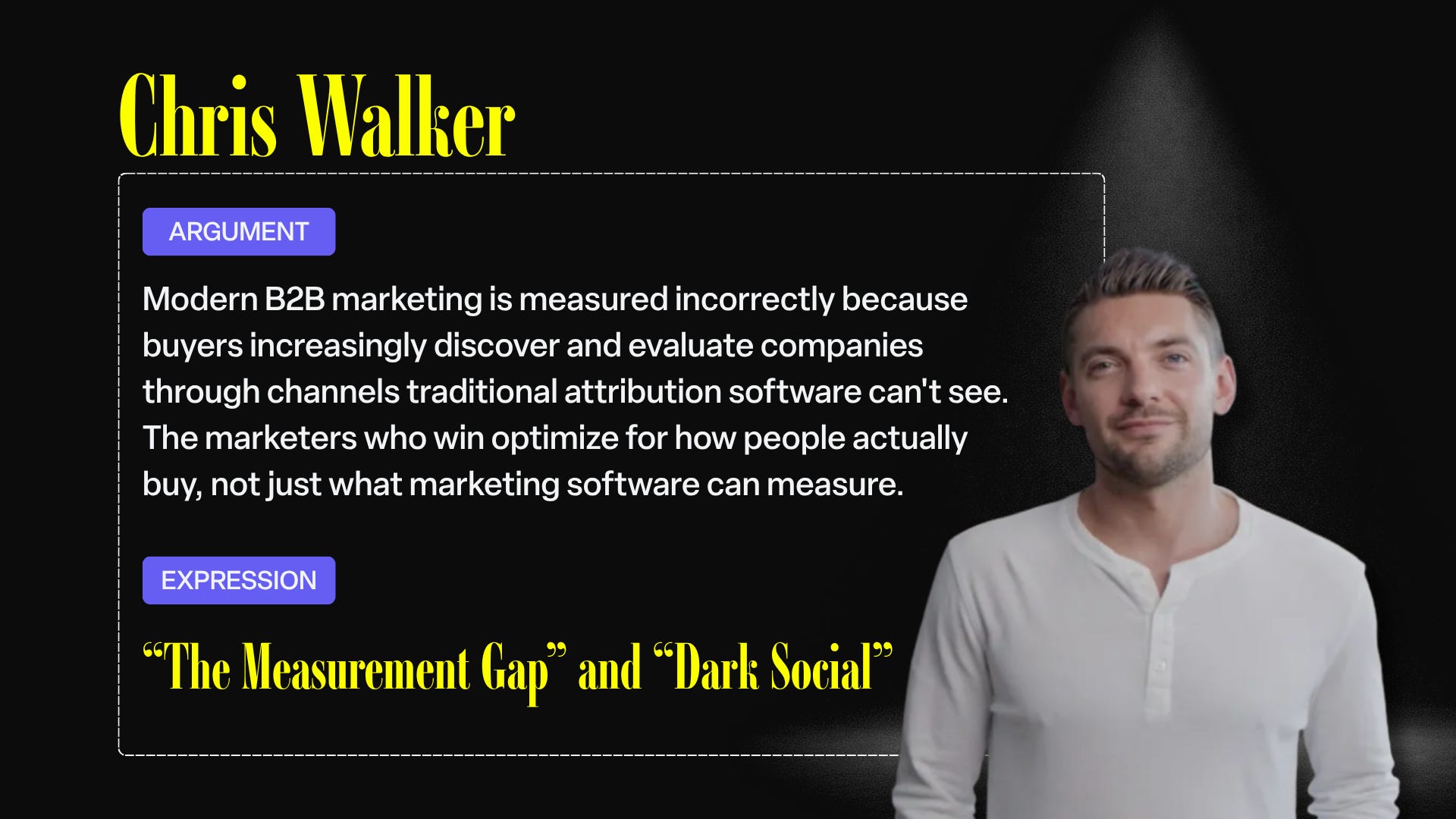
Chris Walker ran a 12-month study tracking 620 customers and $21.5M in sales before he identified a problem in the data and a phenomenon driving B2B purchases that many marketers ignored. That argument—expressed helped him build Refine Labs into a $20 million agency in three years.
None of these Ownable Ideas appeared fully formed.
The entrepreneurs saw something others glossed over, did the work to understand it fully, and then gave it language the world could repeat. They then committed to that language long enough for the world to connect it to them. It’s a lot of work, but it pays off massively.
Notice something else about those three examples: the expressions don’t all look alike.
One names a new category of marketing discipline. One reframes a human trait as a philosophy to live by. One names a problem and the phenomenon behind it. That’s because an Ownable Idea can be expressed in different forms.
Want to find the seeds of your Ownable Idea?
I kick off every 1:1 client project with my Rebel POV exercise.
It’s an AI prompt that interviews you to extract your differentiated beliefs—the stuff that contrasts with popular opinions in your industry (aka the raw material of an ownable idea).
Wanna try it free? Grab it here >
Let’s look at the six distinct shapes an Ownable Idea can take…
The 6 Types of Ownable Ideas
I didn’t invent these six types. I discovered them.
After studying dozens of entrepreneurs who’d become synonymous with an idea, I kept asking the same question—what exactly did they own?—and a pattern emerged.
The ideas weren’t all the same shape.
Some named a problem. Some defined a new way of being. Some offered a belief to live by.
Just know, these aren’t six different ideas to choose between. They’re six ways the same underlying argument can be expressed and become ownable.
The types aren’t a ranking, so one isn’t better than another. It’s about finding the best vehicle for your argument that’s authentic to how you think, matches what your buyers want to hear, and gives you a foundation strong enough to build from… for years.
Type 1: Distinctive Philosophy
A Distinctive Philosophy is a belief about how things should be done that others can live by.
This is the type most people picture when they think of a thought leader. It’s a worldview—a conviction so clear and repeatable that people organize their thinking around it.
Marie Forleo’s “Everything Is Figureoutable” is the belief that every problem has a solution if you’re willing to find it. The real obstacle isn’t the problem. It’s the story you tell yourself about it.
Ramit Sethi’s “Live Your Rich Life” flips conventional budget your money advice on its head and gives people permission to stop feeling guilty about how they spend.
Seth Godin’s “Remarkable or invisible” is the belief that in a world of infinite choice, average is the riskiest strategy of all.
What makes a Distinctive Philosophy powerful is that when people adopt your philosophy, they begin to feel like it’s theirs too.
That’s when consistency bias kicks in: having claimed the belief, people are pulled to act in line with it and to defend it as their own. The belief becomes self-reinforcing. This is why a philosophy, once it takes hold, is so durable and spreadable.
Ramit Sethi is a great example. While other financial experts preached deprivation and ruthless budgeting, Ramit flipped the script. His philosophy, “Live Your Rich Life,” is a battle cry against the false belief that financial freedom means sacrifice.
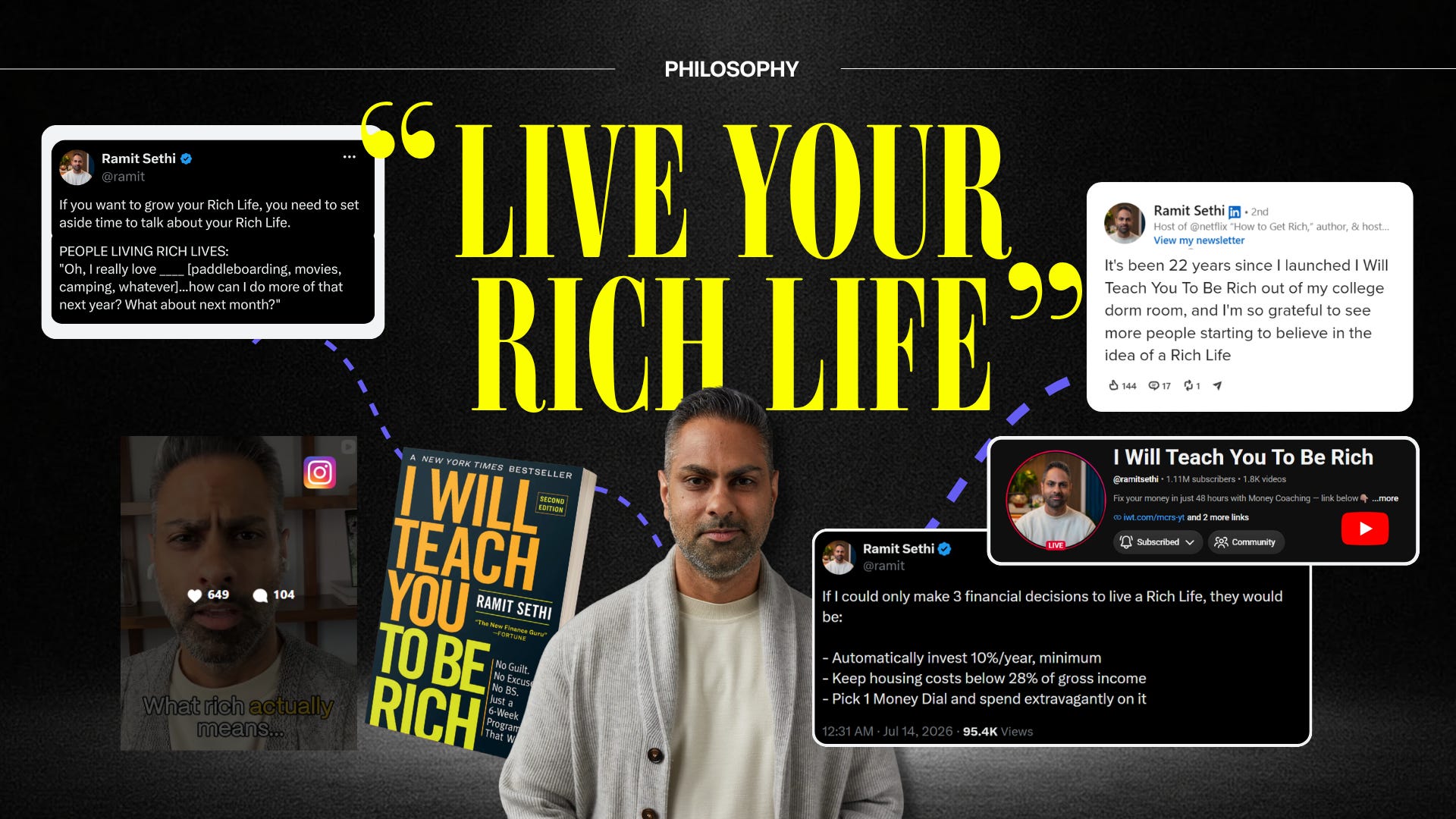
Ramit’s audience doesn’t see themselves as penny-pinchers following someone else’s rules. They see themselves as wealth builders reclaiming permission to spend on what makes them happy.
When it’s authentic and lands in the right place, an ownable philosophy can catch on faaaaast. Simon Sinek’s “Start With Why” took off the moment it hit the TED stage.
What makes it hard: You can’t just declare a philosophy. It has to be earned through lived experience and expressed with genuine conviction. It also has to be shareable in a few words, with high stakes, in a way people can repeat at dinner tables and in team meetings without prompting.
The tell-tale signal: You keep coming back to the same belief about how things should be done, even when people disagree. It’s something you’ve held for years, not something you invented for marketing.
Type 2: Coined Problem (or Phenomenon)
This is one of the most powerful and accessible types of Ownable Ideas because the raw material is already out there.
A Coined Problem names what hurts. It’s a struggle people recognize but don’t have words for. Think “Imposter Syndrome” or “The Law of Shitty Clickthroughs.” The buyer feels recognized: “Yup. That’s exactly what I’m dealing with.”
A Coined Phenomenon names what’s happening. It’s a force shaping their world that they’ve felt but never seen clearly. Think “Psychological Safety”, “Grit”, or “The Long Tail.” The buyer feels oriented: “Oh, ohhh! That explains so much.”
Both work the same way. You give a name to something your buyers are experiencing but can’t articulate. Psychologists call it the Rumpelstiltskin Effect—once something has a name, it feels real, knowable, and solvable. And the person who did the naming becomes the default authority on it.
Sometimes a Coined Problem and a Coined Phenomenon can even work together.
The storytelling work Chris Walker did when he was the CEO of Refine Labs is a great example.
First, Chris named a problem his target clients recognized but couldn’t quantify: “The Measurement Gap”. His company ran a 12-month study tracking 620 customers and $21.5M in sales, and found a 90% gap between where attribution software said revenue came from and where customers said it came from.
The revenue was coming from places the software couldn’t see: podcast listens, LinkedIn comments, and peer recommendations in Slack communities. Chris named this invisible buying territory that drove most B2B buying decisions, “Dark Social” (the phenomenon).
Once someone recognized the problem and the buying pattern—supported by their own buying behavior—they couldn’t unsee it.
It gave marketers language to go to their CEO/CRO and request more budget to invest in creating content that gets spread on “Dark Social”, which was exactly what Chris’ agency, Refine Labs, could help them do.
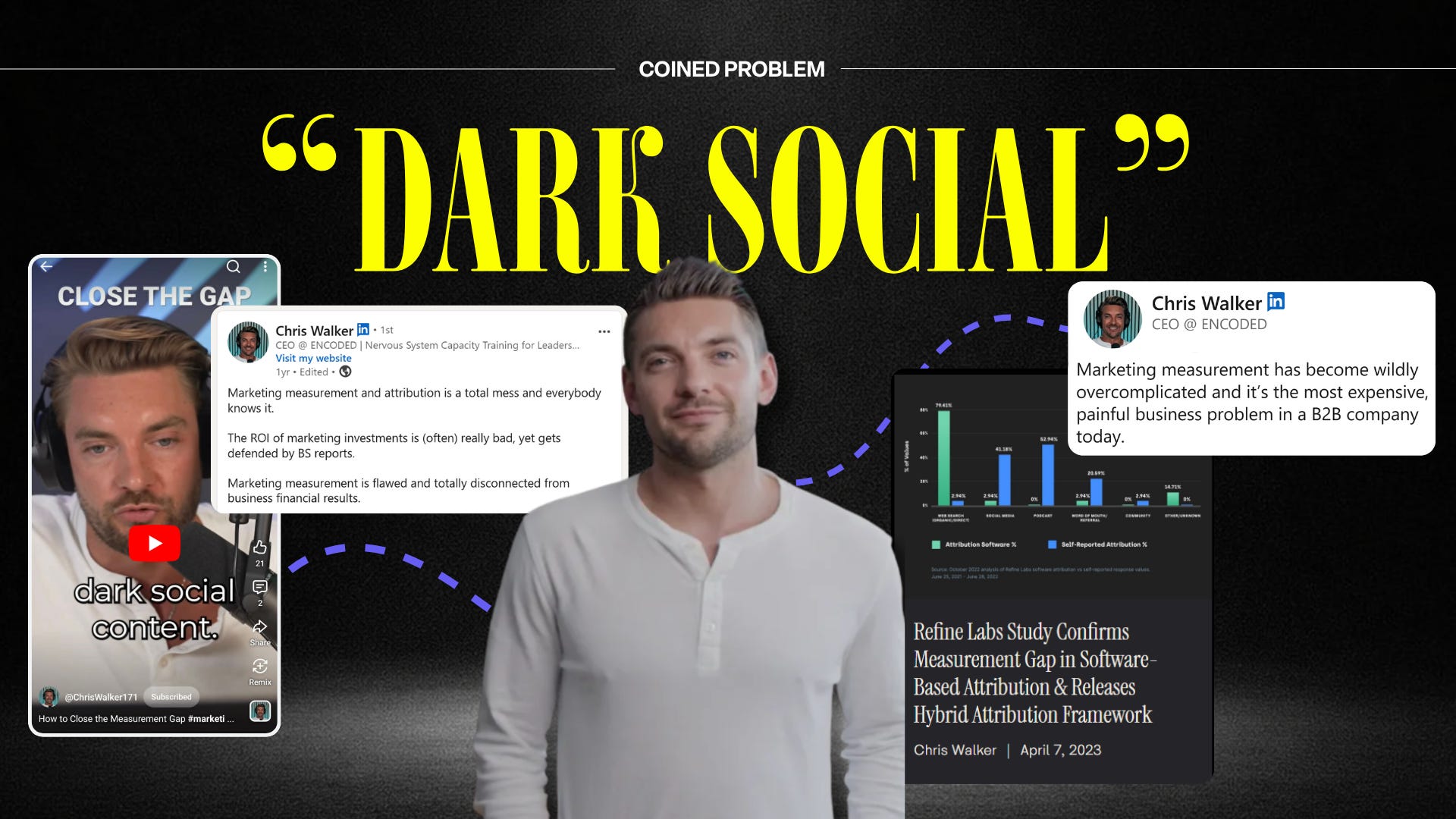
With this compelling argument, Chris went from being an unknown marketer to being deemed “the father of modern demand gen”. He grew Refine Labs to a $20 million business in three years, sold it in six, and built an audience of over 173,000 LinkedIn followers.
Now, Chris is running the same playbook with his new company, ENCODED (cool product, btw). And it’s working beautifully.
What makes it hard: The thing you name has to be something people are already experiencing, not something you’re inventing. It needs to feel like recognition. It should make them say, “Yes, that makes so much sense. I just didn’t have words for it before.”
The tell-tale signal: Your clients keep describing a frustration or shift in their world in vague, imprecise terms: “I just feel like something’s off” or “Everything’s changed, and I don’t know how to explain it.” You have a sharper name for it than they do.
Type 3: Method or Framework
A Method or Framework is a repeatable system people can follow to solve a specific problem.
Where a Coined Problem names the pain, a Method or Framework delivers the cure. The strongest frameworks don’t just organize information—they compress complicated thinking into something people can immediately understand, remember, and teach to someone else.
Alex Hormozi’s Value Equation is a perfect example. Hormozi first shared the Value Equation in his breakthrough book, $100M Offers. This framework compressed his complete approach to creating valuable offers into a single framework. If someone understands the mechanics of the Value Equation, they walk away with Hormozi’s complete thesis on how to create $100M offers.
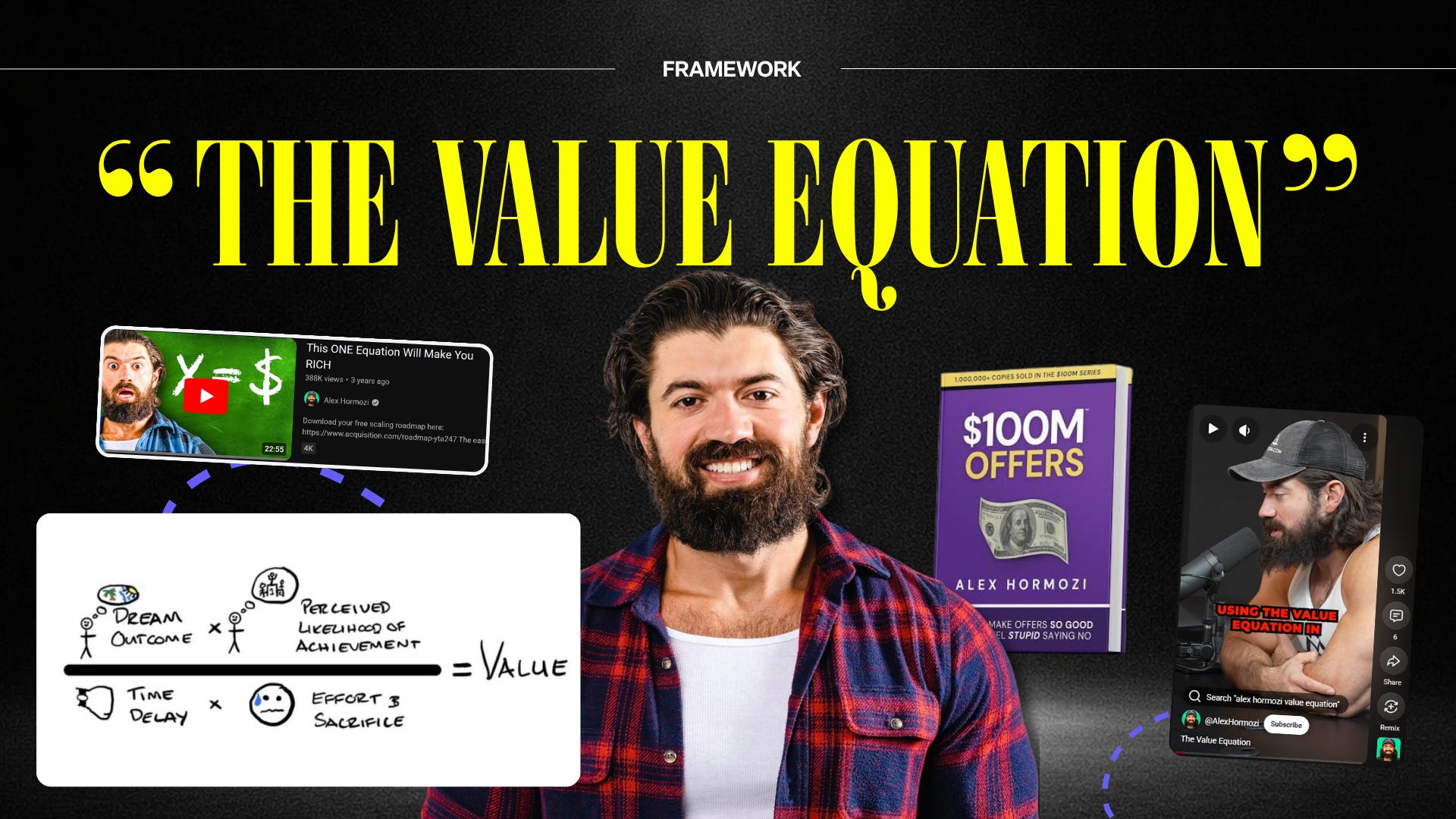
The framework isn’t the insight—it’s the compression of the insight.
Hormozi’s first book made him blow up online, and it became the foundation of the empire he built afterward. Gino Wickman did the same thing with his Entrepreneurial Operating System (EOS), and Donald Miller with the StoryBrand Canvas.
What makes a Method or Framework stick isn’t novelty. It’s simplicity.
This works because of cognitive fluency—our brains trust what’s easy to process. So the framework that makes something difficult to grasp feel obvious wins over the one that’s more complete but harder to understand. The most powerful frameworks make a tough concept feel easy.
What makes it hard: The framework has to reliably produce results. It can’t just be well-structured or cleverly named. A framework built on theory alone collapses the moment someone tries to use it. That’s why Gino Wickman spent years refining EOS with clients before he published a word.
The tell-tale signal: You do the same work repeatedly and have already mentally mapped it into steps. You just haven’t formalized or named the process yet. Your clients keep asking, “Do you have this written down somewhere?” That’s the signal that you have the raw materials.
Type 4: New Category
A New Category defines a new type of solution or market space.
This is the type most people think of when they hear “Ownable Idea.” It gets the most hype, and it’s the one many entrepreneurs misunderstand.
There are two very different ways to end up owning a category, and they differ sharply in difficulty.
The first option is creating a category. This is when you introduce an entirely new type of solution and educate the market to recognize and buy it. This is often called “category design” or “category creation”. When it works, it’s powerful. Billion dollar brands like Hubspot, Airbnb, and Spanx used this approach.
But category creation is also the highest-risk move in this book—especially for expert entrepreneurs.
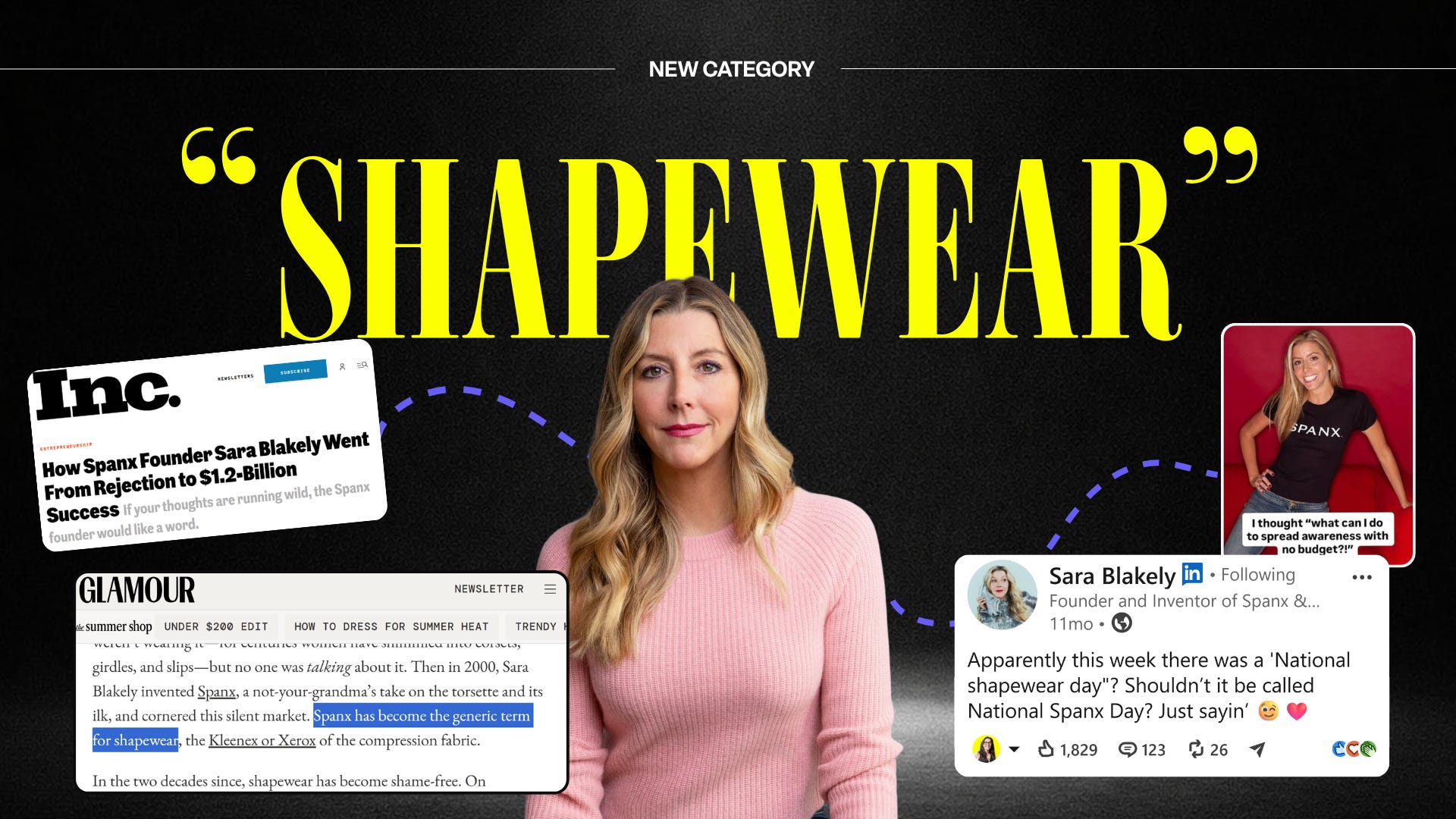
Creating a category means generating demand for something nobody’s searching for yet.
It often takes time and resources to help the market understand why they’d want something new.
For most expert entrepreneurs selling their thinking, creating a category is unnecessary, because people buying services shop within existing categories that have budget and demand. For instance, businesses are already looking to hire “copywriters” today, but they may not know they need a “Narrative Velocity Strategist”.
The second, and far more accessible option is claiming a category.
You take language that exists—sometimes barely used, sometimes floating around unowned—and you give it new meaning, a story, and relentless repetition until the market associates it with you. You’re not generating demand for a new concept. You’re planting your flag on existing ground nobody bothered to own.
This is what Justin Welsh did with the term, “solopreneur”.
Many people are surprised to learn that he didn’t originally coin the term. (Terri Lonier, a brilliant UNIGNORABLE Challenge alum, coined it in the 1990s.) But Welsh brilliantly reframed it and told a compelling story that gave it new meaning.
That’s what I did with “Buyer Psychology”, too. This was the first idea I became known for, and being recognized as ‘the buyer psychology expert’ helped me build my 7-figure a year business as a solopreneur. But I didn’t create this category—I claimed it.
When I launched my Why We Buy newsletter, “behavioral economics” was the accurate term for what it’s about. But that language was academic, cold, and aimed at the wrong audience. So, I chose “Buyer Psychology” instead. The language existed, but no one had built a body of work around it in the marketing space.
I framed it around a problem my readers already felt (the exhausting speed of marketing change), built a catchy philosophy around it (Marketing changes fast. People don’t. Learn Buyer Psychology.), and repeated it everywhere… for… yeeeears.
Eventually, people started calling me “the buyer psychology expert”—and then started using my language to describe the problem.
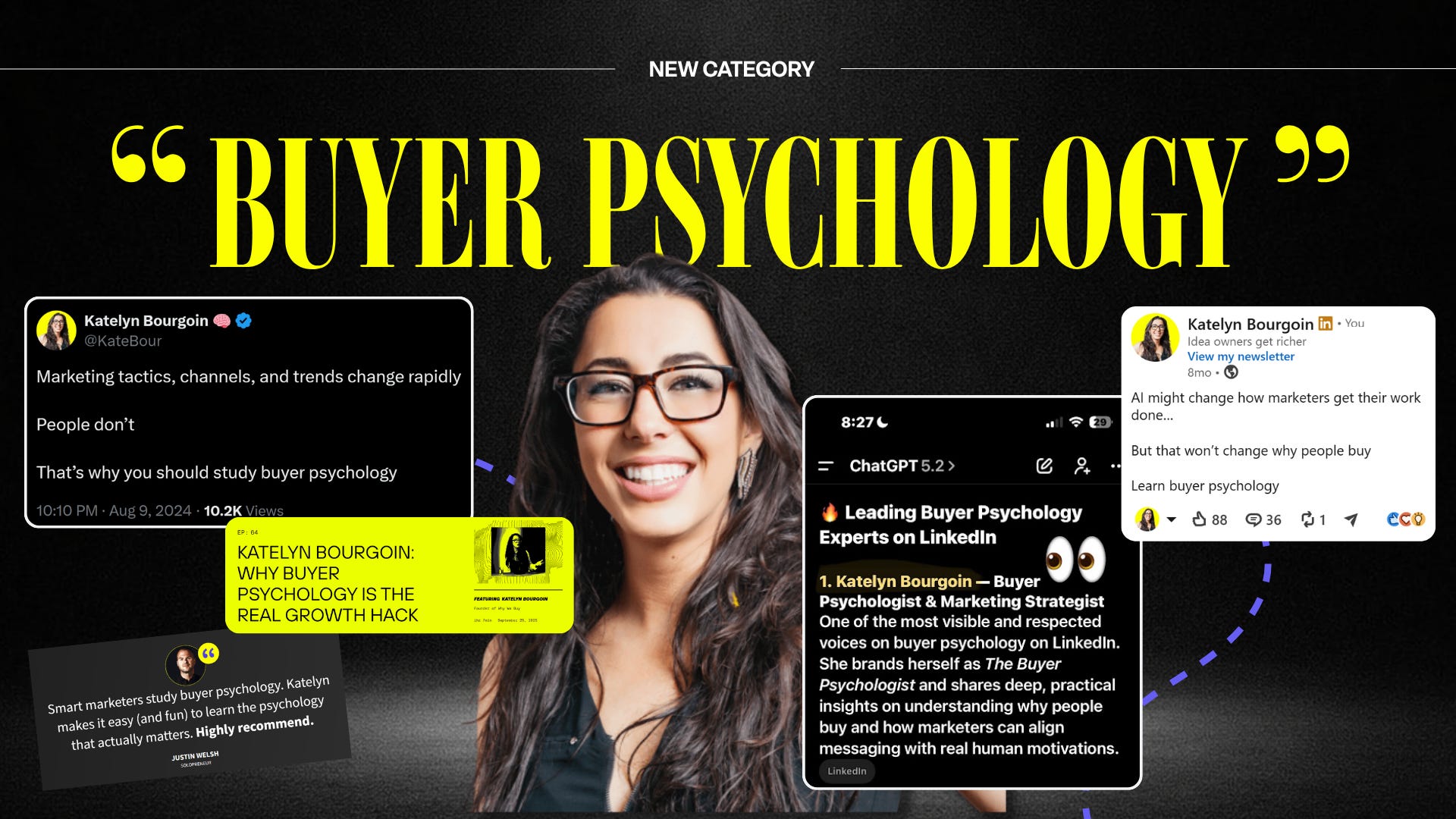
Even ChatGPT recognized me as the leading buyer psychology expert on LinkedIn. This was pretty crazy since the other people mentioned after me were OGs like Robert Cialdini (the author of Influence) and Rory Sutherland (arguably one of the most respected marketers alive today). Crazy, right?
What makes it hard: Creating a category means educating a market that isn’t looking for you yet. Claiming one is often far more practical, but it still requires the judgment to spot language worth owning and the consistency to make it yours. Either way, you need the patience to repeat your framing until the market reflects it back.
The tell-tale signal: You keep using the same phrase to describe your work, it feels more natural than the alternatives, and every time you say it, people immediately understand what you mean.
Type 5: Identity Label
An Identity Label gives buyers a new way to think about themselves. Unlike a philosophy or framework, the question it answers isn’t “what do I believe?” but “who am I becoming?”
That’s what makes identity such a powerful force. People adopt them, defend them, and introduce themselves using them. Behavioural scientists call this in-group identification.
The idea spreads because people wear an identity like it’s their own.
Think of how Sean Ellis created “Growth Hacker.” Before Sean, that work existed—it was scrappy, data-driven marketing happening at startups. But there was no name for it. Sean coined the idea in 2010 and, suddenly, there was an identity worth claiming, a community worth joining, and a career path worth pursuing.
The label spread because people wanted to become the kind of person it described. In his popular blog, Andrew Chen argued that “Growth Hacker Is The New VP Marketing”.
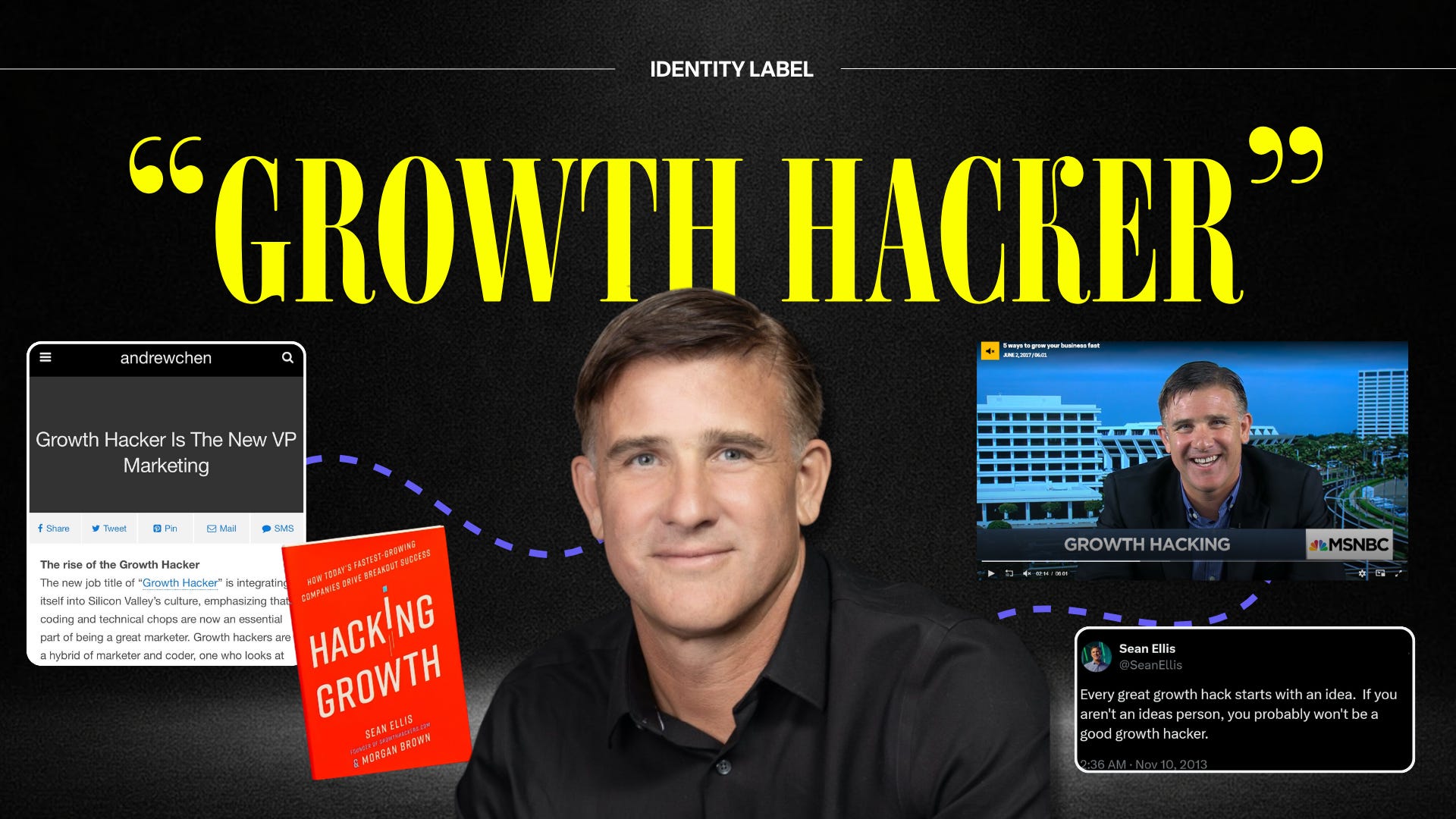
The specific language Ellis chose helped his idea travel. While many engineers would cringe at being called a “marketer”, they were proud to become a “Growth Hacker”—someone who deliberately chose to blend creativity, analytics, and scrappiness to move the needle. Ellis gave them an aspirational identity to step into, and a new generation of growth geeks was born.
What makes it hard: The label has to be aspirational, not just descriptive. “Startup Marketer” is descriptive. “Growth Hacker” is aspirational. The difference is whether people want to say “I’m one of those” and mean it proudly. If the label doesn’t create that pull, it won’t spread.
The tell-tale signal: Your audience is currently doing or becoming something they can’t quite describe yet. They’re circling an identity without the words for it. You have a word that makes them sit up straighter when you say it out loud.
Type 6: X vs. Y
An X vs. Y frames a this-or-that distinction that changes how people see their choices.
This is the most underrated type. It works by introducing a binary—two things that seem similar on the surface but are fundamentally different. Once the reader sees the distinction, their perspective is forever changed. Every decision they make in that domain gets filtered through your frame.
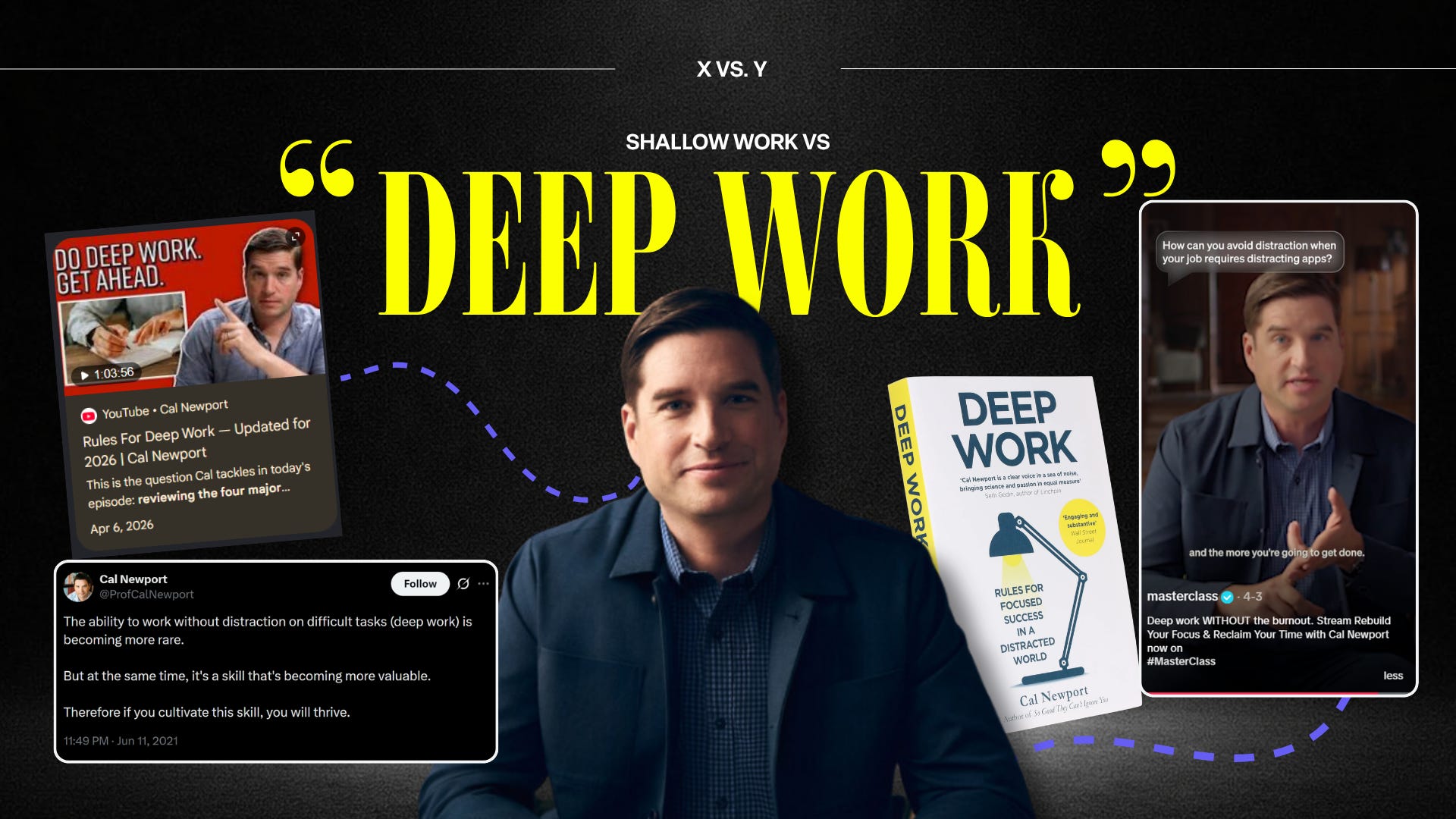
Cal Newport did this with “Deep Work vs. Shallow Work.”
Before Newport owned the idea, people knew their days felt fragmented, but they didn’t have the language to explain why. He gave them a binary: deep work (cognitively demanding, distraction-free) vs. shallow work (logistical, easily replicated) and a way to balance both.
Ben Horowitz did this in The Hard Thing About Hard Things with “Wartime CEO vs. Peacetime CEO.” A Peacetime CEO grows and optimizes a winning company, while a Wartime CEO fights for survival and breaks the rules to do it. It’s the same person, using opposite playbooks. Once leaders saw the distinction, they understood why advice that worked in one mode kept failing in the other.
When you introduce a binary comparison, people understand their options and accept your rules.
What makes it hard: The X vs. Y distinction has to reveal something true and meaningful. It can’t be a clever label for an obvious difference. The realization has to live inside the comparison itself. If the two sides feel arbitrary or forced, the frame doesn’t stick.
The tell-tale signal: You keep explaining things to clients in terms of “the difference between X and Y,” and they keep saying, “I never thought about it that way.” That phrase is the signal. You’re sitting on an X vs. Y ready to be named.
One Argument, Many Expressions
Now you might be wondering: can I own more than one expression?
Heck yes—in fact, many of the wealthiest experts do.
Take Donald Miller. He’s best known for his StoryBrand canvas (a framework)—an 8-part process for crafting messaging. But Miller also teaches the hero-versus-guide distinction (an X vs. Y) and frequently says “if you confuse, you lose” (a problem he’s coined and repeats often).
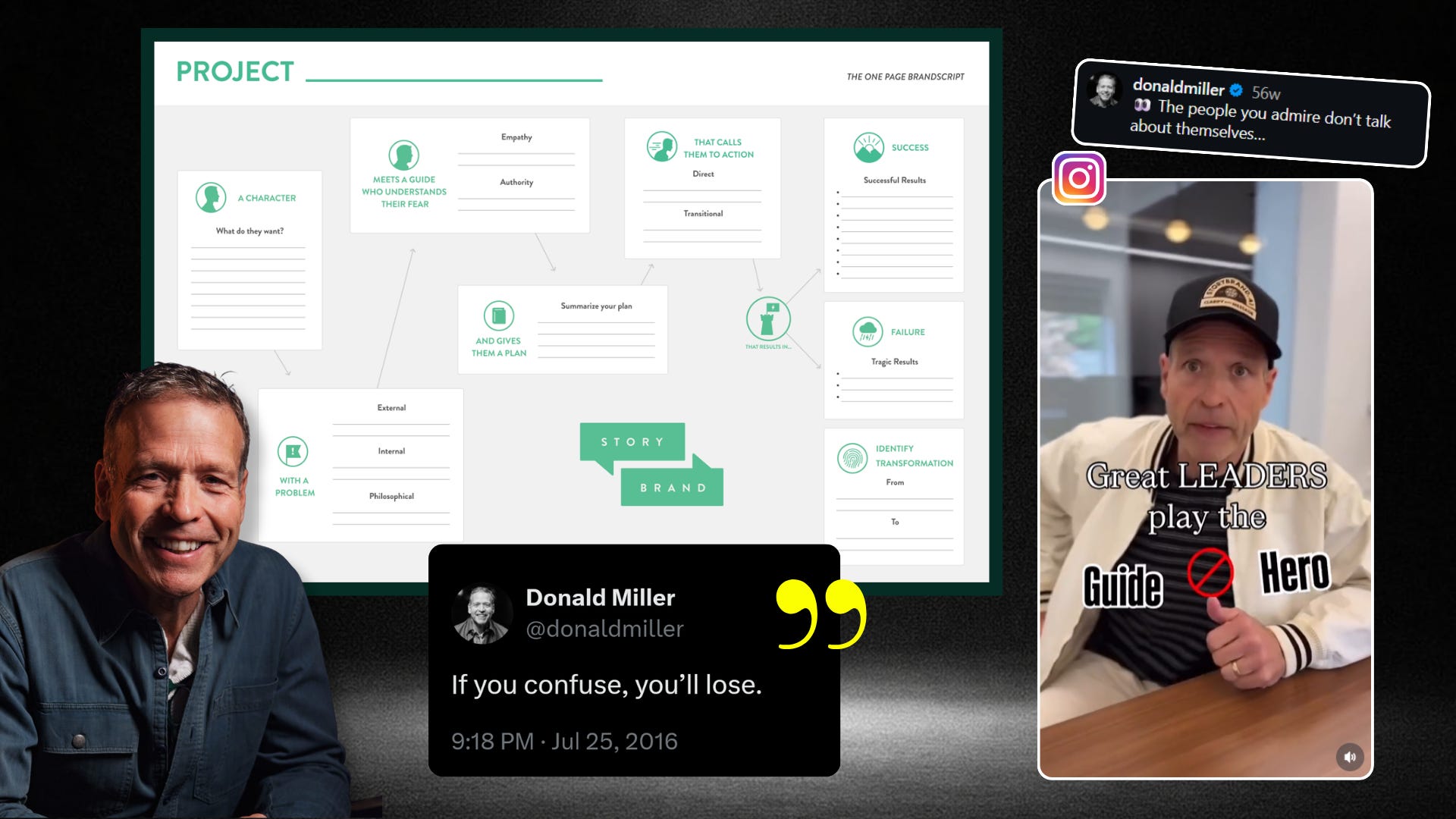
These aren’t three different ideas—they’re three ownable expressions pointing back to the same argument.
Miller has made one clear argument for over a decade: marketing fails when a business makes itself the hero instead of the customer. That argument made him a best-selling author (and a very rich man).
Today, that idea hardly sounds novel because his thinking has spread to a whole generation of marketers. But when Miller first wrote his book, that was an eye-popping concept that stood in direct opposition to how most businesses marketed.
A word of warning: there’s a difference between many expressions of one argument and simply being scattered.
Codie Sanchez can post about pricing, hiring, and loan negotiations in the same week without feeling scattered, because every topic ladders back to one argument. Her topics range widely, but the core idea never moves.
A core argument is how you build compound authority.
Most people do the opposite—they topic-hop, never committing to one argument worth repeating. That’s a great way to stay painfully invisible.
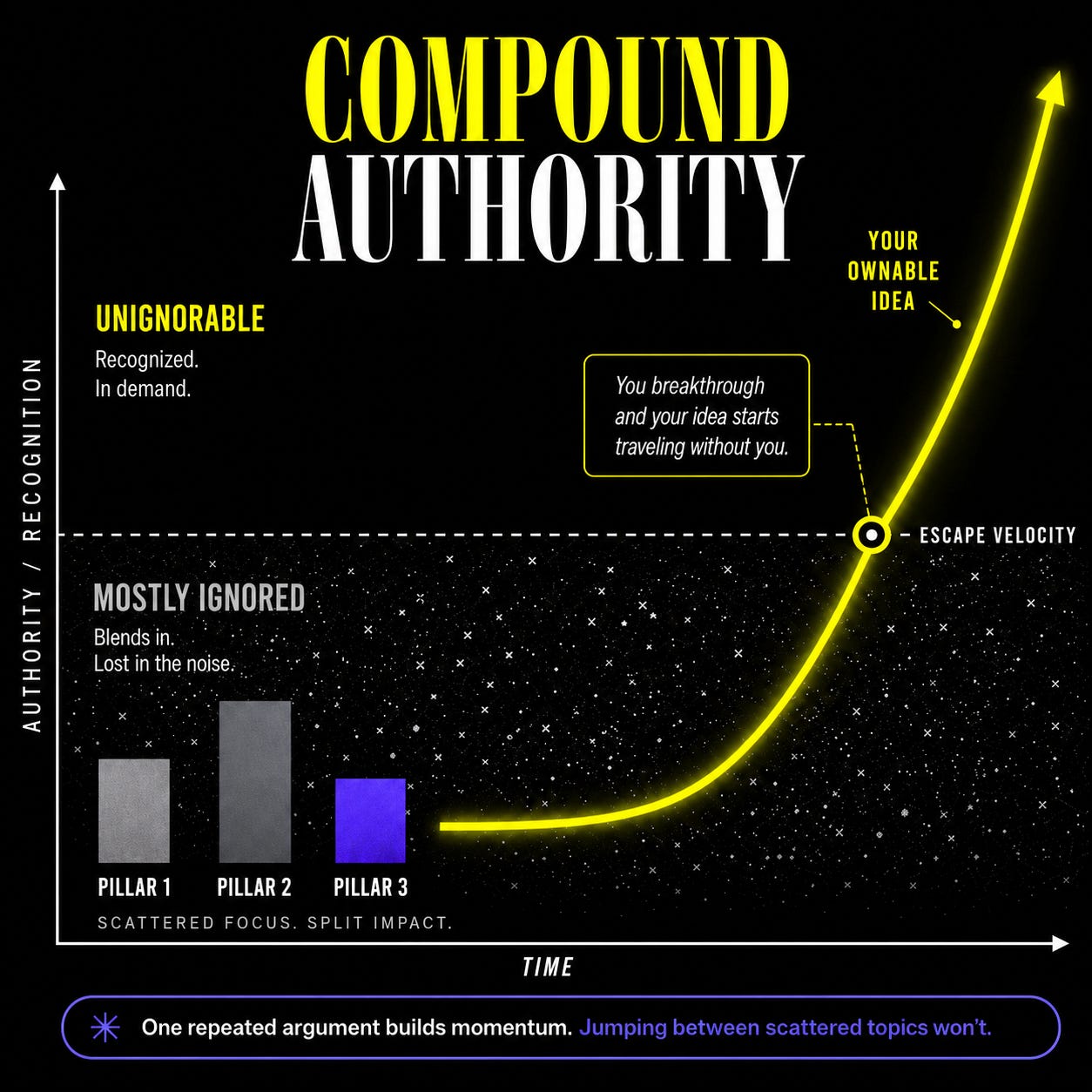
So don’t agonize over which specific words or frameworks to use. Your first job is to find the one argument worth building around, then commit. What you do next depends on your business.
Some double down on a single argument so completely that they become synonymous with it, like Donald Miller or Codie Sanchez. Others expand, using the authority their first idea earned to move into adjacent territory, like Seth Godin or Nir Eyal. Both wrote books sharing disruptive ideas and went on to explore new yet related concepts, writing multiple best-sellers.
Doubling down tends to suit service, education, and product businesses, where being the trusted choice in one lane is everything. Expanding often suits authors, speakers, and creators who make their money by reaching ever wider audiences. Both can work.
Either way, start with one argument that you own completely.
That’s the idea that changes the trajectory of your business (and life). I’m proof.
But Isn’t This Just Positioning or Personal Branding?
It’s a fair question, and one I’ve been asked a few times. The answer is yes… and no.
Good positioning is foundational to everything I do. Before you can build an Ownable Idea, you have to understand who you’re serving, what they want, what’s standing in their way, and why your perspective and approach are different from alternative solutions. Without doing that upfront work, you don’t have the raw material to build a compelling argument.
Positioning matters and is one of the most important strategic disciplines in business. An Ownable Idea doesn’t replace it. It’s built on top of it.
Most positioning advice was designed for companies selling products, and it works backward from a fixed starting point.
You build the product, then position it so buyers understand why it beats alternative solutions. But when your thinking IS the product, the sequence can flip. The idea can come first, and your business can bend around it. That’s why an Ownable Idea doesn’t just help you attract more clients—it often creates new monetization opportunities.
When Codie Sanchez made her first TikTok video preaching about the money-making power of boring businesses, she didn’t have anything to sell yet. Her contrarian argument came first. Her business empire—her courses, media company, software, investment fund—all grew out of it.
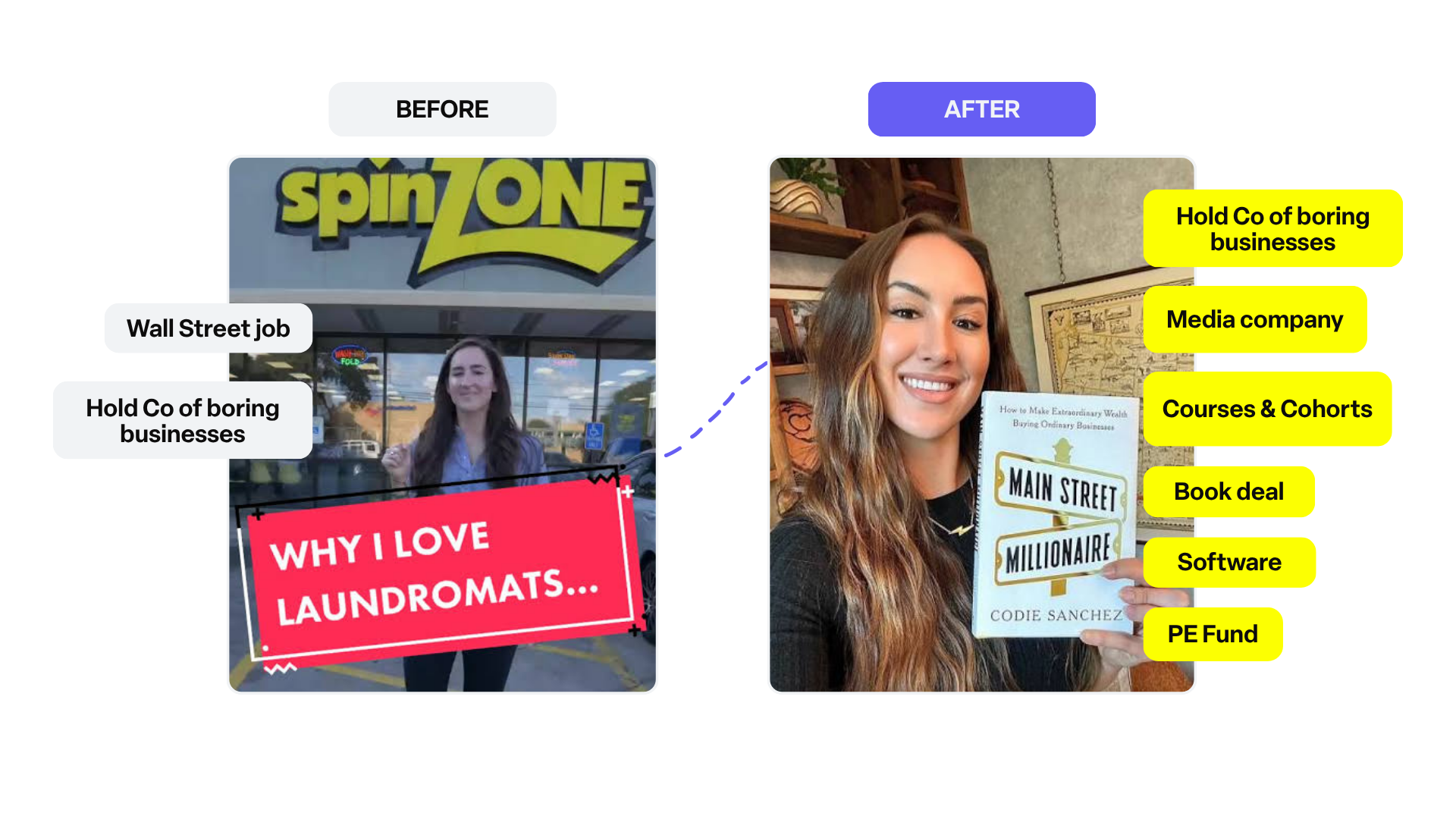
Positioning helps buyers understand what you offer. An Ownable Idea helps compress your point of view into something that sticks and spreads. Get it right, and your authority compounds.
People also ask how an Ownable Idea is different from a personal brand.
I’ve helped nearly 1,900 people build profitable personal brands, so I say this with love: they’re related, but they’re not the same thing.
Everyone has a personal brand whether they’re thoughtful about it or not. It’s your reputation, the way you show up, and a set of things people associate with your name, even if you’ve never once “worked on” it.
Not everyone has an Ownable Idea, because an Ownable Idea has to be built on purpose.
One of the many things that frustrates me about the personal branding space is that so much of the conversation is tactical. It’s all about hooks, content formats, posting cadence, algorithm hacking—the mechanics of getting attention. That advice isn’t wholly wrong, but it operates at the surface. It can help you become recognizable. But being known won’t, on its own, make you known for something valuable.
I’ve watched people build large audiences sharing consistent, viral content… and still be broke. Because being known isn’t the same as being needed. An Ownable Idea, done right, reframes how someone sees their problem, and that shift is what makes them want to work with you.
So no, an Ownable Idea isn’t a replacement for a personal brand. It’s the most valuable thing inside one.
Why You Don’t Have An Ownable Idea Yet
By now, you might be thinking: if my Ownable Idea is in my head, why can’t I see it?
There’s a specific reason, and it has nothing to do with how smart or experienced you are. If anything, it’s the opposite. You’ve had moments where you said something in a client meeting (an offhand observation, a way of framing a problem) and watched the other person’s face change.
They leaned forward and said: I’ve never thought about it that way before.
And you thought: Really? That’s just... obvious.
That moment is often the *flashing neon sign* pointing to your Ownable Idea.
Most experts walk right past it.
This is what I call the Expert’s Paradox—the deeper your expertise runs, the more your best insights feel like common sense.
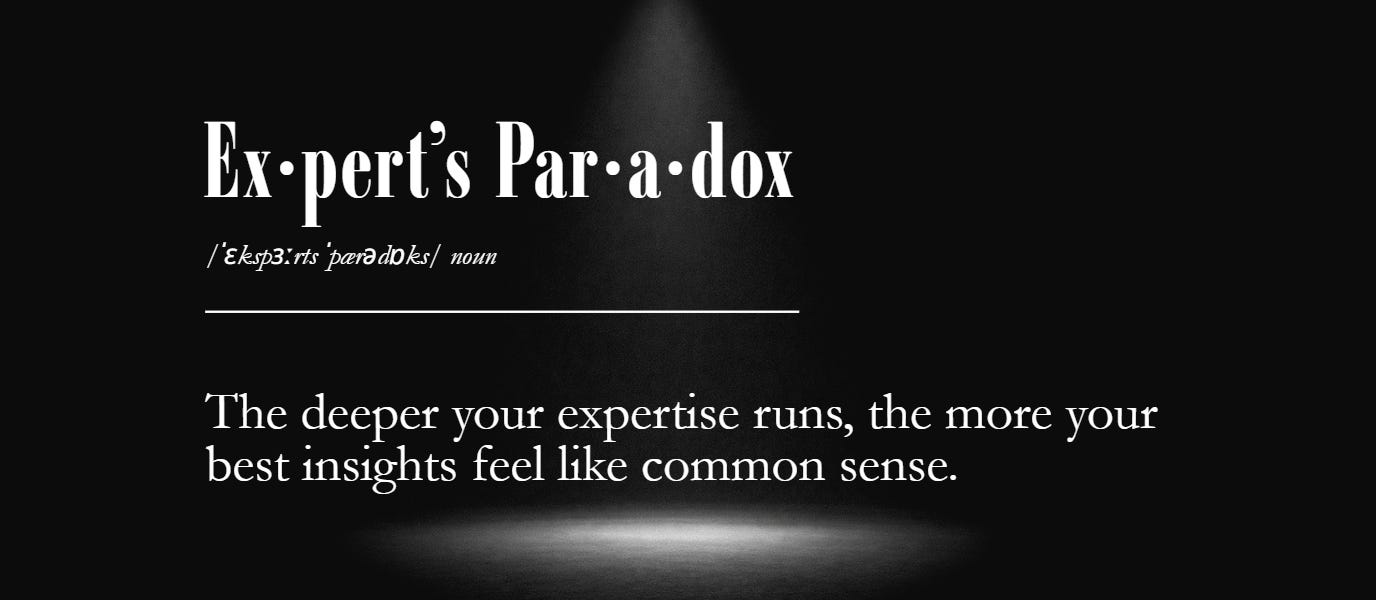
You’ve lived with your ideas so long they’ve lost their texture. What took you years to learn now feels like something anyone would know. So you skip past it and default to general tips, how-tos, and “valuable content.” You get more engagement, but it doesn’t lead to more sales. You know your messaging is off, but you can’t figure out what to say. You’ve rewritten it a hundred times, and it still feels meh.
This happens when you’re too close to your own brilliance to see your idea.
You’re running a service business that eats every available hour. You have proposals, client work, and discovery calls. Unlike full-time creators, you can’t spend three hours a day going deep into your ideas. And the better you are, the busier you get. Which leaves even less time to find the very idea that would make your excellence visible at scale.
That’s the Expert’s Paradox at work. It makes your most distinctive thinking feel “too obvious” to share, and leaves you too busy to slow down and find it. Thinking harder won’t get you out of it. Neither will another marathon brainstorm.
Escaping it isn’t about thinking harder. The work is recognizing what’s already there, shaping it into something shareable, and committing to it long enough for the world to catch on.
Commitment is where almost everyone falls down.
The cruelest irony of Ownable Ideas is that people get bored with their idea long before their audience does.
They land on a genuinely compelling argument, share it a few times, then drift to the next angle—well before their audience has the chance to connect it to them. The people who become synonymous with one idea aren’t the most insightful. They’re the ones who kept showing up with the same argument until the market couldn’t think of the topic without thinking of them.
That discipline is only getting more valuable. As AI makes execution cheap and easy to imitate, the advantage shifts to the people whose thinking can’t be mistaken for anyone else’s.
Expertise creates the value. An Ownable Idea makes the market see it.
Don’t Just Share Ideas, Own One
Every expert who breaks through owns one idea that travels without them.
What happens after the breakthrough is different for everyone. Donald Miller has spent more than fifteen years building around the StoryBrand Canvas framework. Nearly everything he’s created traces back to that one Ownable Idea.
My path has looked different. Buyer Psychology became the foundation of my newsletter, speaking, and education business. Five years later, I’m ready to build around a new idea—Ownable Ideas. (Sooo meta, I know.)
Your first Ownable Idea gives you options.
You might spend the next twenty years building around it. Or it might help you break through, and become the foundation for whatever comes next. Either way, you need the first idea before you get to decide what’s next.
That’s how authority compounds.
People remember what you stand for. They recommend you using your language. And they open doors you’ve never imagined because of your reputation.
You don’t need to own your idea in everyone’s mind. Just in the minds of the people who matter to your business. That’s a much smaller, more achievable target than it feels right now.
One Ownable Idea can change the trajectory of your business and life.
This book answered one question: What is an Ownable Idea?
The next question is harder: How do you find yours?
That’s what the next mini-book is about. I’ll walk you through the four stages every Ownable Idea passes through:
Find.
Shape.
Promote.
Own.
We’ll start by uncovering the strategic territory already hidden within your experience. Then, we’ll shape it into an argument people remember, a message they repeat, and an idea the market begins to associate with your name.
In the meantime, start collecting your evidence. Notice the moments when someone leans forward. Write down the thing you keep explaining. Save the sentence a client repeated back to you.
You can’t see your Ownable Idea from the inside, but you can gather clues that will point you straight to it.
Until next time, Katelyn
Can't wait for the next mini book?
Start where my 1:1 clients start: the Rebel POV Finder exercise.
It’s an AI prompt that interviews you like I would and surfaces the beliefs you hold that your industry would argue with. Those rebellious beliefs are the seeds of what could become your Ownable Idea (and lead to your first breakthrough).
One of the best Substack posts I’ve read this year. What a beautiful gift you’ve given your readers (me!). Thank you.
Katelyn, thank you for every word in this. Thank you mentioning about the expert paradox, I have experienced it and thank you so much for opening up my eyes 🙏 Can’t wait to read the next and now going for the exercise.